
About  me
& science
(& design)

  • PhD in Neuroscience
  • Masters in Evolutionary Biology
  • Degree in Biotechnology
  • Masters in Graphic Design
  • Diploma in Scientific Illustration

My work as a scientist

  • 2021–2026 Alicante, Spain Researching in evolution of the brain cortex in reptiles, birds and mammals
  • 2020–2021 Dresden, Germany Researching in evolution of the human neocortex
  • 2019–2021 Leiden, the Netherlands Researching in ecological networks between fungi, plants and pollinators
  • 2018–2019 Valencia, Spain Researching in cell therapy for spinal cord injury

Publications

  • Fernández Ortuño, E., Cárdenas, A., et al. Developmental divergence of neurogenic strategies during amniote cortex radiation. In preparation (under review).
  • Singh, A. et al., Fernández-Ortuño, E., et al. (2024). Gene regulatory landscape of cerebral cortex folding. Science Advances. DOI: 10.1126/sciadv.adn1640
  • Fernández Ortuño, E., Fischer, J., et al. (2022). Human-specific ARHGAP11B ensures human-like basal progenitor levels in hominid cerebral organoids. EMBO Reports. DOI: 10.15252/embr.202254728
  • Espinós, A., Fernández-Ortuño, E., Negri, E., & Borrell, V. (2022). Evolution of genetic mechanisms regulating cortical neurogenesis. Developmental Neurobiology. DOI: 10.1002/dneu.22891
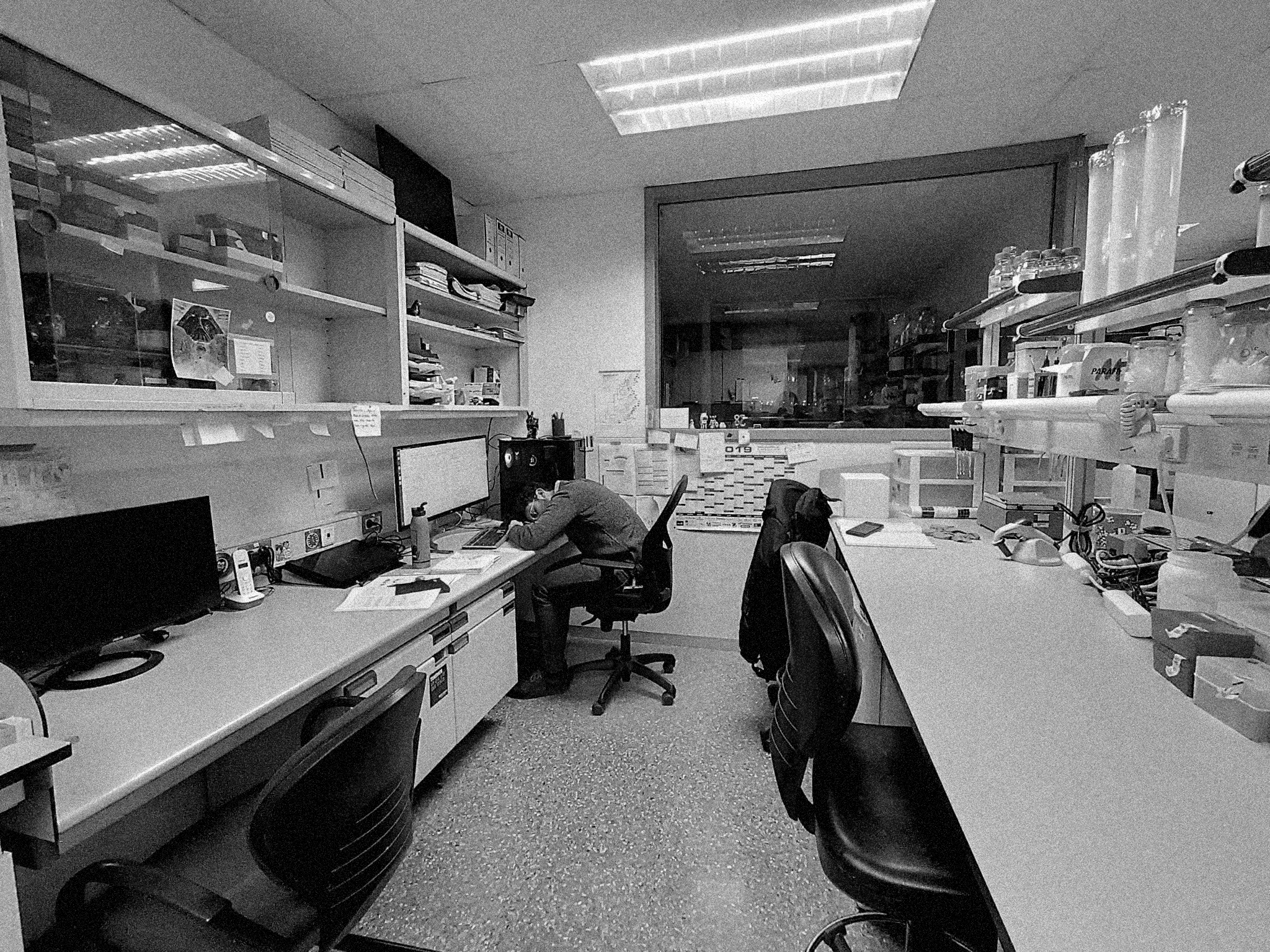
Laboratorio de investigación, vacío, de madrugada
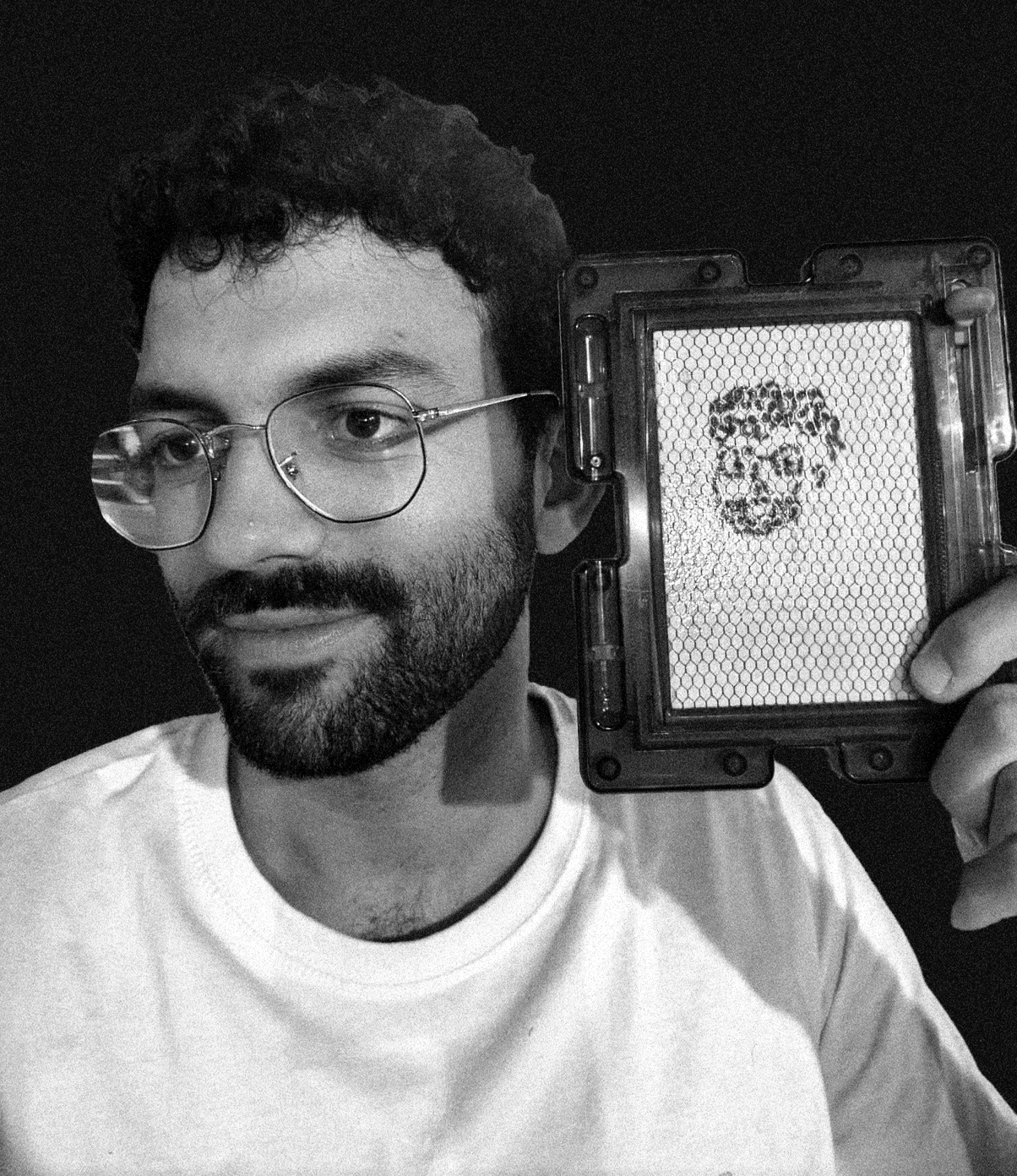
Retrato de Edu sosteniendo un pequeño marco magnético

I am Edu, a biotechnologist and neuroscientist. I grew up wanting to understand so many things about nature. So I started a scientific career, which led me to visit several amazing research fields in different laboratories. I worked on cell therapy for spinal cord injury in Valencia, went to South Africa to research on ecological networks between fungi, plants and pollinators, studied a master’s on evolutionary biology in the Netherlands, grew brain organoids of chimpanzee and human in Germany and finally made my PhD on brain evolution between birds, reptiles and mammals back in Spain.

Along the way, and since much earlier, I carried always a pencil in my hand. I draw almost constantly. It is a natural drive of mine, and a need almost like breathing.

I have always had this dichotomy in my head, between the curiosity to explore and think through science, and the drive to make artistic creations.

Now, I want to merge both and am set to bring the wonders of science closer to society through design and illustration. But in doing so, I want to make sure that the essence of science stays. Let me share with you my vision about that.

I’d say science is all about these three fundamentals

Curiosity

Method

Progress

Ilustración de dos esferas, una grande y una pequeña

“Eppur si muove!”
Galileo Galilei

1 | Curiosity

It all starts simply by wondering what’s out there, by feeling an internal drive to discover and understand. Looking at trees and wondering how they grow, looking at ants and wondering where they go. It might seem simple, but the act of making questions is of utter importance, and has had huge consequences for human societies. This is because it takes us closer to a truth beyond dogmas. Galileo knew it very well back in the 17th century. It was by feeling curious about the night sky and looking at it, that he could confirm it was the Earth that moved around the sun, and not the way around. This was an objective truth, that remains real above any human myth or belief. Something he knew very well; no matter what the inquisition made him say, still he knew that, “yet, it (the Earth) moves”.
2 | Method

However, it is not enough with just looking, as our own perception can deceive us. To avoid this, the method must be applied to make sure whether we are right or wrong. Systematically, after proposing an explanation for what we see — a hypothesis — we must gather data (a lot of data) by doing experiments. This frequently will lead us to surprising discoveries, which will in turn lead to new questions.

Indeed, the knowledge we obtain is not final. It evolves and changes, for doubt is the birth of science, its guide and its fuel. The scientific method takes us closer to the truth and to achieve great breakthroughs, but it also shows us the immensity of what we do not know. Therefore, it makes us humble and aware that we might be wrong. And I firmly believe this act of doubt makes us more just.

Ilustración de cuadrados en composición diagonal

“The entire method consists in the order and arrangement of the things to which the mind’s eye must turn so that we can discover some truth”
René Descartes

Ilustración de dos triángulos formando un reloj de arena

“Nothing in life is to be feared. It is only to be understood”
Marie Curie

3 | Progress

By understanding nature, we can take advantage of it, create astonishing technologies, and improve our life and our care for the planet we live in.

However, we must be careful in doing so, as this great power can be used for great damage.

Philosophy and humanism are key here, in granting that the breakthroughs and marvels science brings are used to progress towards a better future.

Science must stay human.

Today, in the middle of this fourth industrial revolution, information and AI are at the center of the stage. Because of the infodemics we live with, with massive abundance of misinformation, I believe it is crucial that the rigor and critical thinking of science permeate society. Every person must have the capacity to doubt, to think freely, and to discern the fact from the hoax.

I hope this project can contribute to it :)

You have explored this far. Why not keep it going?

Let’s say hi